Wellbeing · Slow living
How much fits
inside one head
Stress feeds on full diaries, but also on wardrobes, screens and tiny decisions that pile up. What the data says, and why living with less can be more than a trend.
In 1936 the endocrinologist Hans Selye published a short note in Nature about rats exposed to cold, injury and exhausting exertion. Whatever the cause, the body answered with the same pattern. That shared response would later be called stress, a word Selye borrowed from physics, where it names the force applied to a material to test it.
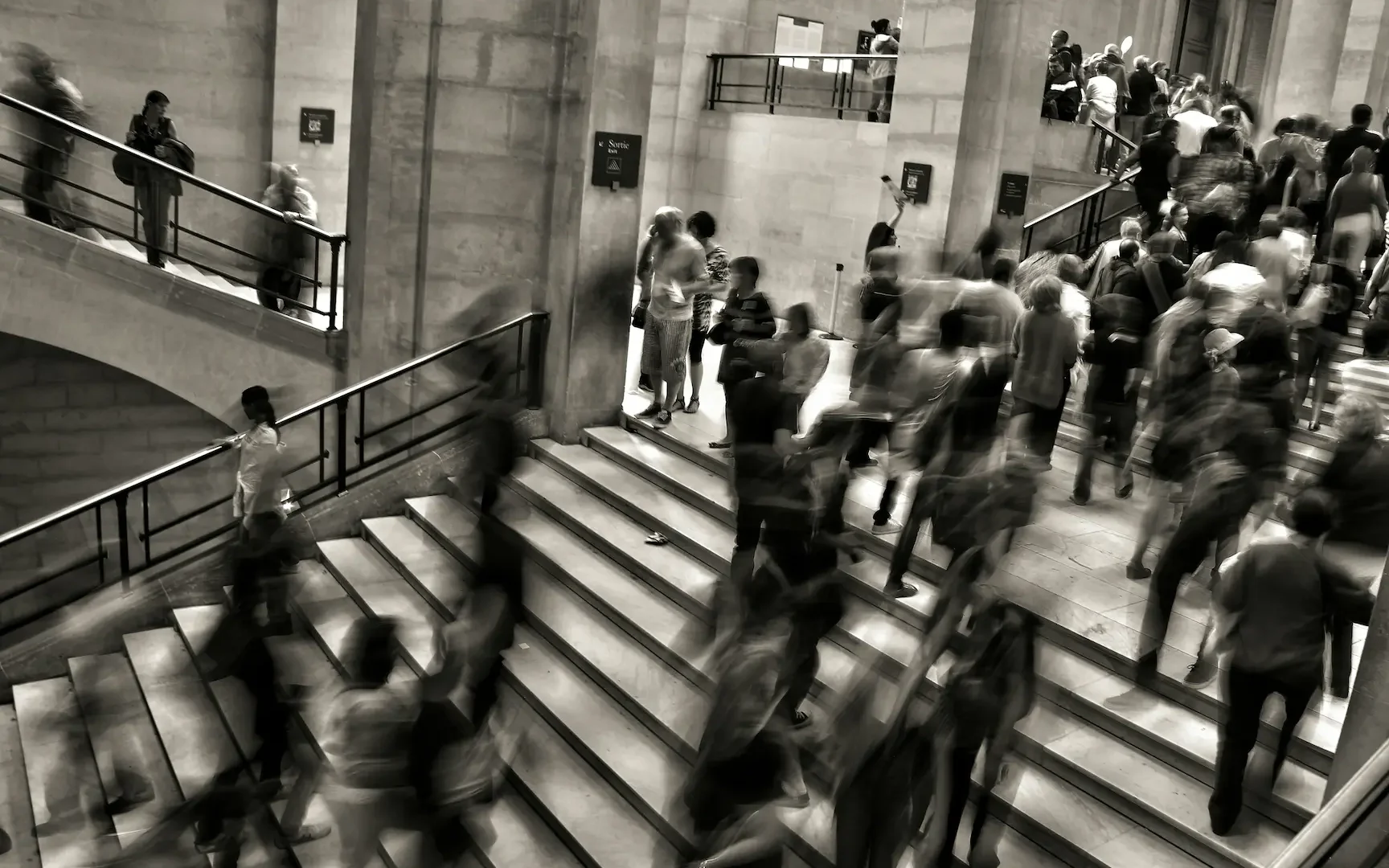
What makes the finding interesting is what it hints at: the body is poor at telling a real danger from a heap of small demands. Hardly anyone runs from a predator now. Plenty of people, though, live with the alarm switched on by an inbox, a notification, a to-do list that never reaches the bottom.
of employees worldwide said they had felt a lot of stress the previous day
Gallup, 2023
working days are lost every year to depression and anxiety, at a cost close to one trillion dollars
WHO and ILO, 2022
The figures say nothing about causes. Gallup did not ask, and assigning them would be guesswork. What they do show is the scale: that so many people find everything uphill is not a personal oddity or a flaw of character. It is a shared experience.
The weight of choosing
In 2000, Sheena Iyengar and Mark Lepper set up two jam-tasting tables in a California supermarket. One offered 24 varieties, the other just 6. The large table drew more curious shoppers (60% stopped, against 40%), yet only 3% of those who stopped went on to buy. At the small table, 30% did.
Later, Barry Schwartz and colleagues looked at something else: how people live who hunt for the best possible option in every decision, whom they called maximizers. They reported less happiness and more regret, perfectionism and depressive symptoms than people who settle for something good enough. Choosing a lot is tiring. Always choosing the best is exhausting.
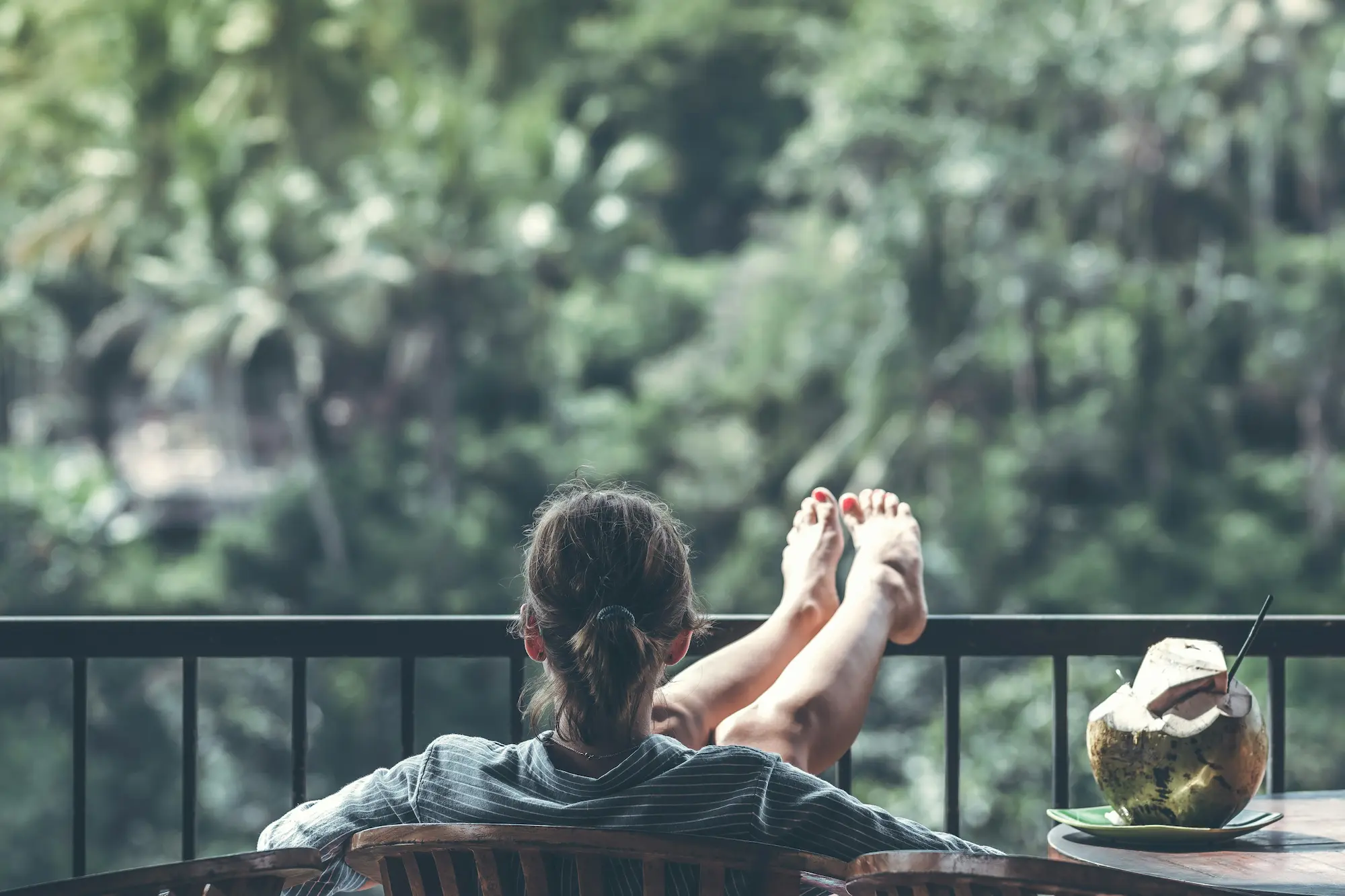
Stopping is also a decision.
This is where the slow living idea that less is more starts to make sense, and not as an aesthetic of white, empty rooms. The point is to cut down the number of decisions a person carries around each day. Buying little and well saves time, money and attention. What gets used daily, what touches the skin, what is breathed at home or brought to the table, deserves more care than an impulse purchase. Natural, responsibly made products do not cure stress, and that is worth saying plainly, but they lighten what the body and the surroundings have to absorb, and they last longer. Things bought slowly tend to be looked after.
“It is not the person who has little who is poor, but the one who wants more.”
Seneca, Letters to Lucilius, II, 6
What cannot be bought
A study of almost 20,000 people in England, published in Scientific Reports in 2019, found that those who spent at least 120 minutes a week in nature reported better health and wellbeing than those who fell short of that threshold. It made no difference whether the time came in one long stretch or several short visits. A local park counts.
Relationships weigh even more. A meta-analysis of 148 studies and over 300,000 people, by Julianne Holt-Lunstad and colleagues, linked strong social ties to a 50% greater likelihood of survival over the follow-up period. Enjoying the people nearby, sitting at a table without hurry, is no luxury. It is one of the best-documented investments in health.
Helping shows up in the data too. In a 2008 experiment, Elizabeth Dunn, Lara Aknin and Michael Norton handed participants 5 or 20 dollars to spend that same day. Those who spent it on other people ended the day in a better mood than those who spent it on themselves, whatever the amount.
Then there is competitiveness. In 1954 Leon Festinger proposed that people evaluate themselves by comparing with others, especially when no objective yardstick exists. In a culture of rankings and shop windows, that comparison never switches off, and rest is impossible while the game is about coming out on top. Celebrating other people’s wins, cooperating, helping without keeping score, eases a pressure almost nobody chose.
What would stop being done tomorrow if nobody were going to find out?
Five small decisions
Replace before adding
When something comes in, something goes out. And what comes in is made of natural materials, made nearby and built to last.
Two hours outside
Split however suits: one long walk, four short ones, a while on a bench in the sun.
A shared table
Eat lunch or dinner with someone, phones off the table, at least once a week.
A favour, unannounced
Carry the shopping for an older neighbour, call someone who lives alone, offer an afternoon.
Muting the comparison
Stop following the accounts that leave a bad taste, and stop measuring the day in results.
Living with less is not a substitute for professional care. If anxiety lasts for weeks, disturbs sleep or gets in the way of daily life, it is worth speaking to a GP or a mental health service.
Almost everything that eases things is small and close by: a person, a walk, a well-made object that will not need replacing. Living with less has little to do with going without. It has to do with making room.
Room for silence, for whoever is next to you, for what you did not yet know you wanted.
Sources and references
- Selye, H. (1936). A syndrome produced by diverse nocuous agents. Nature, 138, 32. doi.org/10.1038/138032a0
- Gallup (2023). State of the Global Workplace: 2023 Report. www.gallup.com/workplace/349484/state-of-the-global-workplace-2022-report.aspx
- WHO / ILO (2022). WHO and ILO call for new measures to tackle mental health issues at work. www.who.int/europe/news/item/28-09-2022-who-and-ilo-call-for-new-measures-to-tackle-mental-health-issues-at-work
- Iyengar, S. S. & Lepper, M. R. (2000). When choice is demotivating. Journal of Personality and Social Psychology, 79(6), 995-1006. doi.org/10.1037/0022-3514.79.6.995
- Schwartz, B. et al. (2002). Maximizing versus satisficing: happiness is a matter of choice. Journal of Personality and Social Psychology, 83(5), 1178-1197. doi.org/10.1037/0022-3514.83.5.1178
- Seneca. Epistulae morales ad Lucilium, II, 6.
- White, M. P. et al. (2019). Spending at least 120 minutes a week in nature is associated with good health and wellbeing. Scientific Reports, 9, 7730. doi.org/10.1038/s41598-019-44097-3
- Holt-Lunstad, J., Smith, T. B. & Layton, J. B. (2010). Social relationships and mortality risk: a meta-analytic review. PLoS Medicine, 7(7), e1000316. doi.org/10.1371/journal.pmed.1000316
- Dunn, E. W., Aknin, L. B. & Norton, M. I. (2008). Spending money on others promotes happiness. Science, 319(5870), 1687-1688. doi.org/10.1126/science.1150952
- Festinger, L. (1954). A theory of social comparison processes. Human Relations, 7(2), 117-140. doi.org/10.1177/001872675400700202
